Pantheon
The Unrelenting Rise of Aseris Jorrell
Most accounts cite the Era of Dominion as inevitable, vast consolidations of power driven by economic weight and military superiority. Contemporary records tell a different story—of how legitimacy broke from inheritance, and how a once-overlooked junior official became the catalyst for a new order.
Kharavel, Fifth World of the Valenne-Jorrell Compact
Sol Calendar 7507.3298 — Early Era of Dominion, Pre-Hegemonic Period
Aseris Jorrell’s violent ascent began during the closing hours of the Concord Summit, an interstellar conference convened to formalize trade and mutual defense among several emergent power blocs. As the delegations assembled at High Tower to finalize negotiations, coordinated strikes from a coalition of breakaway worlds, later known as the Meridian Splinter, disabled planetary communications and neutralized orbital security. Mayhem spread through the fifth capital like wildfire. Within the first thirty minutes, High Tower was destroyed, effectively decapitating the presiding families of the Valenne-Jorrell Compact.
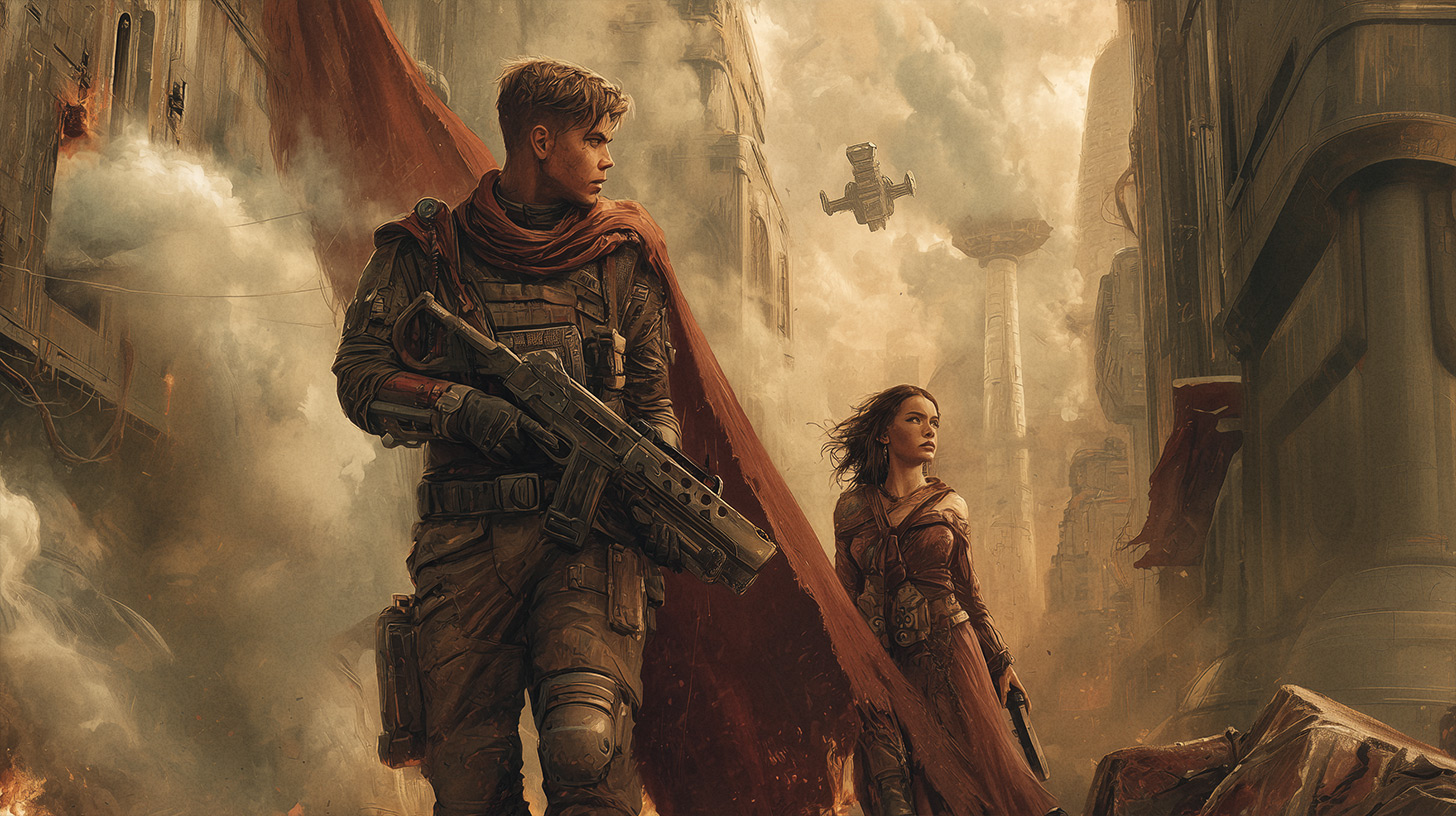
Although the destruction of High Tower was complete, the assault hadn’t gone exactly to plan. Hours before the chaos erupted, Dalen Myrus, a mid-level security officer assigned to Aseris, identified irregularities in communications traffic and personnel movement. When his concerns were dismissed by his immediate superior, Myrus bypassed command, persuading Aseris to leave High Tower under false pretenses. When the first detonations struck the upper districts, Myrus and Jorrell were already moving through the city’s industrial levels, clear of official routes and compromised tracking systems.
At the time, Aseris Jorrell was only a minor authority, widely regarded as politically irrelevant. Her extraction was a gross departure from protocol, initially branded treason. Post-event investigations would later confirmed Myrus had been right. Elements within the Compact had been complicit in the coup, suppressing early warning indicators and delaying response in a calculated bid to position themselves favorably in the new order.
As the coalition’s purge spread across multiple systems, eradicating senior leadership and seizing administrative centers, the Valenne-Jorrell Compact quickly collapsed. Preliminary reports cited Aseris among the High Tower dead, but rumors of her escape surfaced within weeks. Despite confirmation, concerns of overreach kept the breakaway worlds focused on suppressing dissent and asserting control over territories taken too quickly to govern. Jorrell was seen as a manageable liability, a remnant of a failed regime rather than a credible threat. An assumption the coalition would come to regret.
Their constrained response gave Jorrell space to build. Known and hunted, but never cornered, she moved covertly among the outer systems, deftly cultivating alliances. Where the coalition imposed compliance, Jorrell shared visions of autonomous alignment, promising to dismantle the conditions that had made rivalries profitable. Myrus, unchallenged in loyalty and competence, became her right hand. As First General, he transformed displaced military cadres and former security elements into an agile, highly effective force loyal not to banners, but to Aseris Jorrell.
Six years after the fall of the Valenne-Jorrell Compact, Aseris, backed by new alliances, launched a blitzkrieg of decisive strikes. Orchestrated by Myrus, the opening offensive was ruthlessly efficient, seizing key territories and assets in the first three days. Senior officials from coalition worlds disappeared. Transit corridors collapsed, and supply lines failed in sequence. Each action was precise and publicly attributable to Aseris Jorrell, making her intention clear. Prey turned huntress, retribution was the mechanism through which she excised not only those who’d conspired against the old Compact, but also those that stood idle as it fell.
Although relentless, Jorrell’s campaign was never indiscriminate, exposing the Meridian Splinter’s central flaw. Their authority had been built on elimination and control rather than integration and coherence. As the coalition’s leadership fractured, their foundation weakened. Worlds once subdued by force began to defect, aligning preemptively with Jorrell’s emerging political order. She moved quickly to stabilize the territories and worlds brought under her control, ensuring governance was restored and trade resumed. Long-standing faction rivalries were dismantled rather than exploited, stripped of the incentives that sustained them. For many worlds, alignment with Jorrell promised a sustained predictability that had been absent for centuries. It was there, in the newfound calm, that her legitimacy took root.
Three and a half years after beginning her crusade, Aseris struck the last name from her list, becoming the first ruler in recorded history to unite seventeen worlds under a single reign.
Despite the ferocity of her rise, Jorrell’s legacy lay not in her quest for retribution, but in the order she imposed once it was obtained. Though the polity she established was later absorbed and restructured as larger domains coalesced, historians consistently identify Jorrell’s ascendance as a decisive inflection point, and the moment the Era of Dominion truly began.
Visual media from this time rarely depict Jorrell enthroned or triumphant. Instead, she is most often shown as she began, moving through smoke and failing light, uncertain of survival, yet already shaping the future she would later command.